Every perp DEX is racing to build a faster order book. Variational decided the order book is the wrong primitive entirely. Here is the real case and the three things that have to be true for it to hold.
XYZ Crypto Research · 19 August 2026 ·
Lucas Schuermann, Variational's co-founder and CEO, makes an observation that should stop you cold. Even on the most liquid crypto assets — the ones that genuinely trade fine on-chain today — there is still roughly a 100x gap between the depth sitting on Hyperliquid and the depth sitting on the CME.
Sit with that for a second. On the assets decentralised finance is best at, it is still off by two orders of magnitude.
Now ask what that gap looks like for gold. For WTI crude. For Nvidia stock.
It is not 100x. It is uncrossable. And not because on-chain infrastructure is too slow — that problem was solved years ago. It is uncrossable because of who quotes those markets and how they hedge. Understand that one sentence and the entire Variational thesis falls into place.
01 — EVERY ORDER BOOK HAS THE SAME ILLNESS
It is called the cold start problem, and it works like this. To list a market you need depth. To get depth you need market makers posting resting size. To get market makers you have to pay them — rebates, incentives, sometimes equity. Then you repeat the whole exercise for every single new asset, forever.
"Order books have a cold start problem. They're not porting liquidity, they're rebuilding it."Lucas Schuermann, co-founder and CEO
The consequence is visible on every on-chain venue if you look past the top ten tickers: books get dangerously thin fast. You can list five hundred markets. You cannot make five hundred markets deep.
For real-world assets it is worse, and the reason is structural rather than technical. The market makers who quote gold hedge on COMEX. The ones who quote Nvidia hedge on Nasdaq. They will never post passive resting size on an on-chain order book, because the instant they do they are carrying inventory risk against a venue they cannot hedge into instantly at size. That is not conservatism. That is arithmetic.
So every RWA perp venue hits the same wall. Listing is trivial. Depth is impossible.
02 — TRADFI SOLVED THIS FORTY YEARS AGO
Variational's response is not to build a better book. It is to delete the book.
→ You request a quote for a specific instrument and a specific size.
→ The Omni Liquidity Provider returns a firm, executable, all-in price.
→ You accept it, or you walk away. No partial fills against a queue, no slippage surprise.
→ Both sides post margin into an isolated on-chain escrow with pre-agreed margin, liquidation and settlement rules.
Nothing rests. Nothing is public. There is no queue to jump, no book to front-run, no depth to bootstrap. The dealer prices your specific request on demand and hedges it into whichever market is genuinely deepest — CME, Nasdaq, Binance, an OTC desk, wherever the real liquidity lives.
This is not an invention. Request-for-quote is how the over-the-counter world has cleared trillions of dollars for four decades. The invention is doing it with margin held in smart contracts, settlement in stablecoins, and permissionless access.
03 — OLP, AND THE THING EVERYONE SKIPS
The Omni Liquidity Provider is the counterparty to every trade on Omni. Per the documentation it breaks into three parts: a vault holding USDC that serves as OLP's margin and accumulates its profits, a market-making engine running proprietary algorithms against live CEX, DEX and TradFi feeds, and a risk system that continuously hedges out directional exposure.
Here is the line almost every write-up skips. That market-making engine is not new code shipped for a token launch. It is the same engine the founders have been running and refining for more than seven years — first at their own hedge fund, then at Genesis, then at their proprietary trading firm. The protocol was wrapped around a working engine, not the other way round.
What is actually new about it
Vault-as-counterparty is not itself novel. The precise differentiation is sharper, and it comes from Variational's own docs:
HLP (Hyperliquid) — runs a sophisticated market-making strategy, but is not the only counterparty. It participates on a book alongside others.
JLP (Jupiter) — is the only counterparty, but runs a simple AMM strategy rather than an active one.
OLP (Variational) — runs a sophisticated market-making strategy and is the only counterparty. The first vault to do both simultaneously.
That combination is what makes everything downstream possible.
04 — WHY ZERO FEES IS NOT A SUBSIDY
Most exchanges leak. They charge traders a fee, then hand a meaningful slice straight back to external market makers as rebates just to keep the book breathing. Value flows continuously out of the platform to third parties.
Variational owns its market maker. The bid-ask spread that normally leaks out stays inside the protocol. Zero fees for traders does not mean zero revenue for the protocol — that is the entire trick, and it is why Omni can simultaneously offer 0% maker, 0% taker, and refund a portion of losing trades in USDC.
And you do not have to take this on faith. Per the docs, 20% of every spread paid to OLP is routed to the protocol treasury, and that wallet is public on Arbiscan:
0x5e91b40467fb8902c46a7b6cb90482363188d645
A pre-token protocol with auditable on-chain revenue you can check yourself is a rare thing. Go look.
05 — TWO DESIGN DECISIONS THAT GIVE THE GAME AWAY
The standard risk furniture is all present: isolated settlement pools so one trader's liquidation never touches another's margin, partial-only liquidations with a flat 0.5% penalty, an EMA-smoothed mark price to blunt oracle wicks, last-look rejection in extreme volatility, and automated listing and delisting at an EWMA settlement price so no zombie contracts linger.
But two choices are genuinely unusual, and they tell you who built this.
Funds that never leave
OLP never transfers trader funds to external venues. It sends only its own capital out to hedge. If a centralised exchange it hedges on is hacked tomorrow, OLP depositors can lose money — but traders can still withdraw, because their collateral never left the settlement pool.
The liquidation inversion
On most exchanges, auto-deleveraging means your winning position gets force-closed and you simply eat it. On Omni, OLP is a margined counterparty exactly like you are. When OLP is liquidated, that is the ADL event — and the user receives the liquidation penalty, because OLP is the party being penalised. You still get closed out. But you get paid for the privilege.
Neither of those is a coincidence. Which brings us to the two people who wrote them.
06 — A GRUDGE, FORMALISED
Lucas Schuermann and Edward Yu met in their freshman year at Columbia, placed in adjoining rooms in an entrepreneurship-focused dorm. Lucas studied CS and Mathematics as an Egleston Scholar — an honour given to roughly the top 1% of the engineering school — with prior stints at Google X robotics and Goldman Sachs strats. Edward read Applied Mathematics with a focus on Bayesian statistics before moving into quant research.
→ 2017 — they found Qu Capital together.
→ 2019 — Qu is acquired by Digital Currency Group. Lucas becomes VP of Engineering at Genesis Trading, Edward becomes VP of Quant Trading.
→ Genesis was, at the time, one of the largest OTC desks in crypto. They pushed hundreds of billions of dollars of volume through it.
→ 2021 — both leave to start their own proprietary trading firm.
→ January 2023 — Genesis's lending arm files for bankruptcy protection following its exposure to Three Arrows Capital and FTX.
They did not read about concentrated counterparty risk and manual off-chain settlement in someone else's post-mortem. They ran the engineering and the quant desk at the firm it happened to.
Now re-read the design with that in mind. Segregated pools. Collateral that never leaves. A counterparty that must post margin and can itself be liquidated. That is not a feature list. That is a grudge, formalised into architecture.
One more detail that separates them from the field: they raised $10M, ran their strategies profitably for years, integrated with virtually every CEX and DEX in the market, and then used trading profits to fund building the protocol. Roughly 24 people, drawn from Google, Meta, Virtu, IMC and Jane Street. This is not anonymous developers with a fork and a points page.
07 — $61.8M, AND THE SIZE OF THE CLAIM
Three rounds. A $10.3M seed in October 2024 from Bain Capital Crypto, Peak XV, Coinbase Ventures, Hack VC, Dragonfly and North Island. A $1.5M round in June 2025 from Mirana, Caladan and Zoku. And a $50M Series A in May 2026 led by Dragonfly, with Bain Capital Crypto and Coinbase Ventures participating.
"RWA perps will be the biggest contract class in crypto within a year, larger than BTC and ETH perps combined. The platform that wins won't look like a traditional exchange."— Haseeb Qureshi, Managing Partner, Dragonfly
Bitcoin's market cap is around $1.6 trillion. Ethereum's is around $256 billion. That is the size of the claim a $4B fund just underwrote with $50 million.
08 — THEY SAID SUMMER. THEY SHIPPED IN A QUARTER.
Phase 1 landed on 20 May 2026, the same day as the raise: gold, silver, copper and WTI crude perps went live. Deliberately a stress test — run the cross-margin engine and on-chain settlement against aggregated crypto-native liquidity before touching real dealer flow.
Phase 2 was the harder promise: 100 TradFi markets in 90 days. Equities, indices, FX. They hit 100%, with Applied Materials as the final listing on the plan. Most protocols announce a roadmap in May and ship it the following year.
And then Swaps, which nobody is pricing
Announced on 6 July, Variational has signed over $1 billion in open interest capacity with TradFi dealers who will stream liquidity privately into OLP rather than into a public order book. Search "Nvidia" on Omni and you will eventually see two instruments side by side.
NVDA-PERP gives you 24/7 trading and variable funding rate exposure. NVDA-SWAP gives you dealer depth, size without slippage, and a predictable all-in carry of roughly 4.5%.
That distinction matters more than it looks. A perp gives you round-the-clock access and funding-rate roulette. A swap gives you dealer depth and a financing cost you can actually model into a book. Institutions have never wanted the first one.
09 — WHERE IT ACTUALLY STANDS TODAY
Cumulative volume: $199.4 billion
30-day volume: $23.1 billion
Open interest: $1.55 billion — third largest in DeFi
Live markets: around 500, up to 50x leverage
Accounts: more than 50,000
Variational now sits third in all of decentralised finance by open interest, behind only Hyperliquid and Aster — and comfortably ahead of Lighter, which has a live token and a $2.3 billion valuation. All of this before $VAR exists.
The one metric worth arguing about
Volume can be manufactured. Wash trading, incentive loops and points farming all inflate it, which is why headline volume tells you almost nothing about a pre-token venue. Open interest as a percentage of 30-day volume is a far cleaner filter: it measures capital genuinely at risk overnight against capital merely churned.
Hyperliquid — 7.0%
Variational — 6.7%
Aster — 5.3%
Lighter — 2.9%
edgeX — 1.9%
ApeX — 0.4%
Variational's flow density is essentially Hyperliquid-tier, and more than double Lighter's. Positions on Omni are being held, not churned for points. For a venue everybody assumes is pure farming, that is the most surprising number in this entire article.
10 — AGAINST HYPERLIQUID, AGAINST LIGHTER
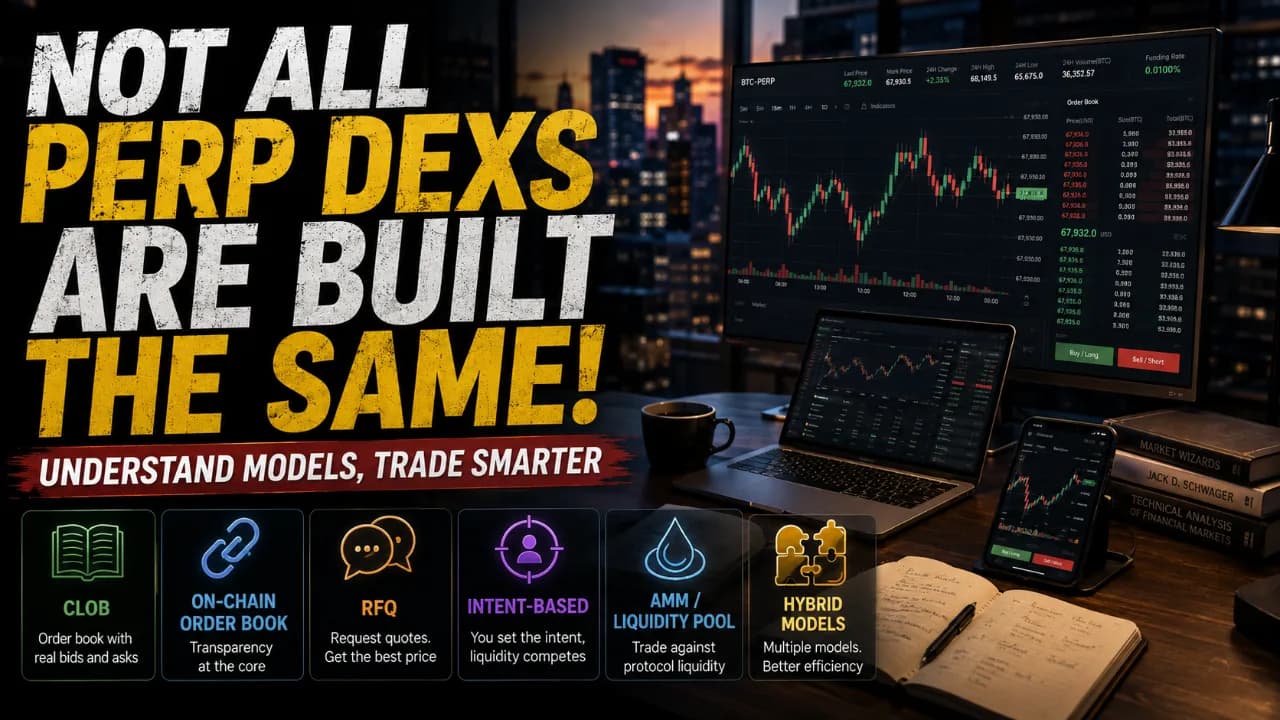
Variational runs an RFQ model with a single dealer, porting liquidity from CEXs, DEXs and TradFi, where the vault is the universal counterparty, order flow is fully private, fees are zero on both sides, and RWAs arrive through direct dealer routing.
Hyperliquid runs an on-chain central limit order book on its own L1, bootstrapping liquidity natively, where the vault participates on the book rather than being the counterparty, order flow is fully public, fees are maker-taker, and RWAs arrive through HIP-3 permissionless builders.
Now the honest part. For Bitcoin, Ethereum and crypto majors, Hyperliquid is simply the better product. Deeper books, faster execution, and genuine price discovery that a single-dealer RFQ vault cannot replicate. It runs $174 billion in 30-day volume and $12.25 billion of open interest — 39% of all perp DEX volume and 62% of all open interest in DeFi. It is not close, Variational is not a threat to it on crypto, and anyone telling you otherwise is selling something.
Lighter went the opposite direction entirely: an application-specific zk-rollup on Ethereum with a verifiable matching engine, using Plonky2 proofs so every match and every liquidation can be cryptographically verified. Lighter optimises for trustlessness. Variational optimises for liquidity access. Both are legitimate. They are solving different problems for different traders, and the market will probably pay for both.
11 — WHAT IS ONE POINT ACTUALLY WORTH?
Before the math, the valuation context — because there is a genuine disagreement sitting in the open right now, and it is the most interesting thing about this trade.
$LIT trades around $2.30, giving Lighter roughly a $2.3 billion fully diluted valuation. Against that anchor, Variational currently runs 166% of Lighter's open interest and 71% of its 30-day volume. Naively, that comps out to about $1.6 billion on the volume ratio and $3.9 billion on the open interest ratio.
Polymarket, with $1.85 million of real money on the line, disagrees sharply. Its live odds on Variational's launch FDV:
Above $300M — 85%
Above $500M — 67%
Above $800M — 43%
Above $1B — 32%
Above $2B — 18%
That curve implies a median around $700 million and a probability-weighted mean near $1.2 billion. So the comparables say $1.6 to $3.9 billion and the betting market says $700 million. That gap is the actual trade here, in either direction. One side is wrong.
The formula
Point value = (FDV × percentage of supply going to points) ÷ total points
At roughly 9.15 million total points, across a range of allocations, one point is worth:
At a $500M FDV — $5.5 at 10%, $8.2 at 15%, $11 at 20%
At a $700M FDV (the market median) — $7.7, $11.5, $15.3
At a $1.2B FDV (the market mean) — $13, $19.5, $26
At a $2B FDV — $22, $33, $44
The mistake almost everyone makes
People see "50% to community" and plug 50 into that formula. The docs say the community allocation is "expected to be distributed over time through various initiatives." Season 1 points are one initiative — future seasons, ecosystem funds and reserves all come out of the same bucket. Assume 10% to 20%, not 50%. Anyone quoting you $50 or more per point is inflating it by a factor of three.
How much is left
The programme launched on 17 December 2025 with 3 million points distributed retroactively, then 150,000 per week every Friday. Running that forward: roughly 35 weeks at 150,000 gives 5.25 million, plus the 3 million retroactive, so about 8.25 million points are already out. From today to the 30 September cutoff is six weeks, or about 900,000 more.
Which means you are now farming for roughly the last 10% of the entire pool. The window is nearly shut, and anyone starting today should size accordingly.
What it costs
$5.393 billion of 7-day volume divided by 150,000 weekly points works out to roughly $36,000 of platform volume per point. With zero fees, your only real cost is spread plus funding. BTC base spread runs around 0.4 basis points per the docs, so round-trip cost lands somewhere near $3 to $8 per point on majors — meaningfully more on alts, where spreads are wider.
A cost of $3 to $8 against a median-case value of $8 to $15. Thin, positive, and entirely dependent on assumptions you should set yourself. Pair selection matters far more than size.
12 — WHAT HAS TO BE TRUE
This is where the word "generational" gets tested rather than asserted. Three things have to hold, and none of them is settled.
One: RWA volume has to actually show up. The overwhelming majority of Variational's volume is still crypto. Phase 2 shipped 100 TradFi markets, so the markets exist — but existing and being traded are different facts. Whether real flow follows the listings is completely unproven, and it is the load-bearing assumption in Dragonfly's entire thesis.
Two: Swaps has to ship, and the capacity has to be real. Swaps is still unchecked on the public roadmap with roughly six weeks left in Q3. A billion dollars of signed dealer capacity is a commitment, not a fill. Until dealers are actually streaming quotes and traders are actually lifting them, it is a very good slide.
Three: open interest has to hold after 30 September. Everything else in this article is opinion. This is measurement. When weekly points stop, mercenary capital leaves — that is not a prediction, it is what happened to Lighter and to every venue before it. If Variational's $1.55 billion of open interest holds through October, the density argument was real. If it collapses, it was farming wearing a good architecture as a costume.
13 — EVERYTHING THAT COULD BREAK THIS
→ Counterparty concentration. OLP is the sole counterparty to every trade. The docs are blunt: "there is a risk that OLP loses money." And if OLP were insolvent, PnL accrued going forward becomes bad debt and would not be paid out. HLP and LLP are backstops on a book. OLP is the entire system.
→ Cost you cannot see. Zero fees is real, but the cost lives inside the spread with no separate line item. Auditing your true execution quality is genuinely harder here than on a venue that charges you openly.
→ No price discovery. No public book means you are a price taker on OLP's quote. Trust it or do not trade.
→ Still team-seeded. The OLP community vault is not open. Nobody outside the team can independently verify the market maker's profit and loss.
→ Still a private beta. "Omni public mainnet launch" remains unchecked on the roadmap. That $199 billion of volume has been done inside an invite-only product — which is either the most bullish fact in this article or the most fragile.
→ Oracle risk on RWAs. On 28 May 2026, Hyperliquid's SPACEX-USDH perp fell around 45% in thirty minutes, liquidating 405 users and $1.51 million. That is category risk, not venue-specific — but Variational is now deep in that category.
→ Audits not public. Zellic and Spearbit audited the protocol, but the reports were not publicly released.
→ Geography. US and Canadian persons are Restricted Persons. VPN circumvention carries real legal and compliance risk.
→ The Lighter lesson. $LIT launched near $4 in December 2025 and trades around $2.30 today, with 25% circulating and team and investor cliffs unlocking from late December 2026. Infrastructure quality and post-TGE price are two entirely different questions. Do not confuse them here.
VERDICT — SO, IS IT GENERATIONAL?
"Generational" is a word people reach for when something is merely large. That is not what it should mean.
A generational protocol changes what the next generation of builders assumes is the default — the way Uniswap made the AMM the obvious answer for spot, and Hyperliquid made the on-chain order book the obvious answer for crypto perps. By that standard, the case for Variational rests on exactly one claim:
The venue that wins real-world-asset derivatives will be a dealer, not an exchange.
If that is right, Variational is not a better perp DEX. It is the first instance of a category, and every RWA venue built after it will be RFQ-shaped whether or not they credit the idea.
If it is wrong — if on-chain books eventually do attract institutional depth, or if RWA perp demand simply never arrives at the scale Dragonfly is underwriting — then Variational is an extremely well-engineered venue with an unusually concentrated counterparty, and a token that trades on farming flow like all the others.
Both outcomes are live today. Anyone telling you it is settled either way is selling you something.
What makes this genuinely worth your attention is not the airdrop. It is that for the first time in a while, a protocol has made a falsifiable structural bet — and then handed you the exact metric to check it with.
Does open interest hold after the points stop?
Mark the date. 30 September.
All figures verified 19 August 2026 and will move. Educational content only, not financial advice. Perpetual futures with leverage can lose you more than you deposit. Do your own research.